
Industry-Oriented Training | ⭐ Hands-On Practical Labs
Oracle 19c/26ai PL/SQL Fundamentals Training
Master Oracle PL/SQL programming and learn how to build powerful database applications using Oracle 19c/26ai. This hands-on training helps you understand PL/SQL blocks, procedures, functions, triggers, packages, and advanced database programming concepts used in real-world enterprise applications.
4.8
- Duration: 40+ Hours
- Course level: Beginner to Advanced
What I will learn?
- Understand PL/SQL architecture and programming concepts
- Write PL/SQL blocks, procedures, and functions
- Work with cursors for data processing
- Implement exception handling in PL/SQL
- Create and manage triggers
- Use collections and records
- Optimize PL/SQL code for better performance
- Debug and manage PL/SQL programs
- Build real-time database applications
About Course
The Oracle 19c/26ai PL/SQL Fundamentals Training at Aalok Institute is designed to help students and professionals learn how to develop logic inside Oracle databases using PL/SQL.
PL/SQL (Procedural Language SQL) is widely used in enterprise applications to automate tasks, process large volumes of data, and build backend logic for applications.
In this course, you will learn how to write efficient PL/SQL programs, create stored procedures, handle exceptions, and work with advanced features like triggers and cursors. The training includes hands-on practice and real-time examples to ensure you gain practical knowledge.
By the end of this course, you will be able to develop, manage, and optimize PL/SQL programs used in real-world database environments.
Career Opportunities After Oracle PL/SQL Training
This course prepares learners for roles such as:
- Oracle PL/SQL Developer
- Junior Oracle DBA
- Database Developer
- Backend Developer (Database-focused)
- Oracle Application Developer
Course Curriculum
- Understanding the benefits and structure of PL/SQL
- Understanding PL/SQL Blocks
- Generating output messages in PL/SQL
- Writing Anonymous PLSQL block
- Identifying the benefits of using the %TYPE, %ROWTYPE attribute
- Variables
- Various Data types
- Bind variables
- PLSQL operators
- Nested blocks
- Implicit data conversion
- SELECT INTO statement
- DBMS_OUTPUT.PUT_LINE
- Nested blocks and Variable Scopes
- Using SQL Statements in PL/SQL
- Retrieving Data in PL/SQL with the SELECT statement
- Using Naming Conventions in DML Statements and data retrieval
- Manipulating Data on the Server Using PL/SQL
- SQL Cursors
- Using SQL Cursor Attributes to Obtain Feedback on DML
- Saving and Discarding Transactions
- SQL Cursors
- Composite Data Types of PL/SQL Records and Tables
- Using PL/SQL Records
- Inserting and Updating PL/SQL Records
- Using INDEX BY Tables
- Using Associative arrays
- Declaring and Using VArrays
- Using %ROWTYPE
- PLSQL Records
- PLSQL Table of Records
- INDEX BY Table
- INDEX BY Table of Records
- What is a cursor
- Implicit and explicit cursors
- Creating cursors
- Using cursors in procedures
- OPEN..FETCH CLOSE construct
- The %NOTFOUND operator
- FOR UPDATE cursors
- What are Exceptions
- Need for handling exceptions
- Predefined exceptions
- User defined exceptions
- Non predefined exceptions
- Raising Exceptions
- Trapping Exceptions
- Exception propagation in nested calls
- The SQLCODE and SQLERRM in-built PL/SQL functions
- DBMS_UTILITY Package for debugging PL/SQL code
- Overview of Functions
- Differentiating between anonymous blocks and subprograms
- Syntax of CREATE FUNCTION
- Benefits of user defined functions
- Executing user defined functions
- Restrictions on function calls
- Creating Functions
- Nested Functions
- Overloading Functions
- Nesting Functions and Procedures
- Functions in Select and DML Queries
- Dropping functions
- Exceptions and Exception handling
- What are Procedures?
- Need for Procedures
- Syntax of CREATE PROCEDURE
- Parameter dispositions
- Formal Vs Actual Parameters
- Parameter passing methods
- Executing procedures
- Overloading Procedures
- Exceptions in procedures
- Syntax of Create Trigger
- Need for Trigger
- Trigger Basics
- Trigger Types
- Database Triggers
- DML Triggers Overview
- Statement Triggers
- Row Level Triggers
- INSTEAD OF Trigger
- SECURITY Triggers
- Trigger Management
- Oracle Internal Tables for Trigger Management
- What are packages?
- Need for packages
- Package Specification
- Package Body
- Private and Public components
- Calling package functions, procedures
- Referencing package constants and variables
- Overloading package subprograms
- Forward declaration of subprograms
- DBMS_SQL
- DBMS_OUTPU
- DBMS_SCHEDULER
- UTL_FILE
- Creating and Managing Server Jobs
- Exporting data in files
- DBMS_METADATA
- EXECUTE IMMEDIATE statement
Requirements
- Basic knowledge of SQL
- Understanding of database concepts
- No prior programming experience required (beginner-friendly)
Course Includes
- 35–40 Hours of Instructor-Led Training
- Hands-On PL/SQL Programming Practice
- Real-Time Database Scenarios
- Practical Assignments
- Certification Guidance
- Course Completion Certificate
Sample Course Completion Certificate
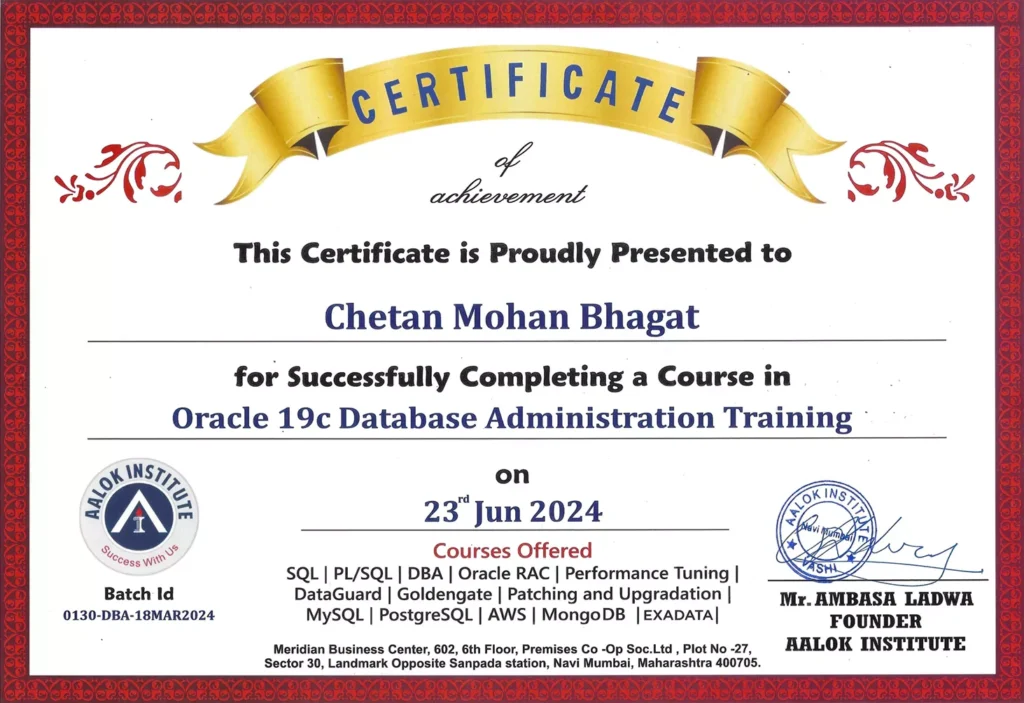
Oracle 19c/26ai PL/SQL Fundamentals Training
Benefits Obtained :
- Live Online & Offline Classes
- PDF Study Materials & Notes Provided
- Real-Time Hands-On Practice
- Course Completion Certification
Why Join Aalok Institute for PL/SQL Training?
- Industry-Experienced Trainers
- Real-Time Database Development Projects
- Small Batch Size for Personal Attention
- Online and Classroom Training Options
- Practical Hands-on Learning
- Job-Oriented Curriculum
Who Should Join This Courses?
This Course is ideal for:

Freshers looking to start a career in database development
Trusted by Professionals from Leading Companies
Students and working professionals from top organizations rely on Aalok Institute for practical DBA and cloud training.









Become an Oracle 19c/26ai PL/SQL Developer
Learn to design, develop, and manage Oracle database programs using PL/SQL programming and Oracle 19c/26ai database features.
Gain real-world skills that help you build scalable and efficient database applications.