
Industry-Oriented Training | ⭐ Hands-On Practical Labs
Exadata Database Machine Administration Training
Master Oracle Exadata Database Machine Administration and learn how to deploy, manage, monitor, and optimize enterprise-level database infrastructure using Oracle Exadata.
4.8
- Duration: 40+ Hours
- Course level: Beginner to Advanced
What I will learn?
- Understand Exadata Database Machine architecture and components
- Learn key capabilities and features of Exadata Storage Server
- Configure and manage Exadata Database Machine
- Implement Exadata Storage Server security
- Monitor Exadata performance using statistics and execution plans
- Analyze Exadata Smart Scan and SQL processing models
- Optimize database performance using Exadata features
- Maintain and monitor Exadata Database Machine infrastructure
About Course
The Exadata Database Machine Administration Training at Aalok Institute is designed to help database administrators and IT professionals gain practical knowledge of Oracle Exadata architecture and administration.
This training covers Exadata hardware architecture, storage server capabilities, Smart Scan technology, database consolidation strategies, monitoring, performance optimization, backup, patching, and maintenance.
Participants will work with real-world concepts including Exadata Smart Flash Cache, Hybrid Columnar Compression, storage indexes, database migration strategies, and database performance tuning on Exadata platforms.
By the end of the training, learners will understand how to deploy, administer, and maintain Oracle Exadata Database Machine environments used in enterprise data centers.
Career Opportunities After Exadata Training
This course prepares learners for roles such as:
- Oracle Exadata Database Administrator
- Data Center Database Administrator
- Senior Oracle DBA
- Database Infrastructure Engineer
- Enterprise Database Architect
Course Curriculum
- Introducing Database Machine
- Introducing Exadata Storage Server.
- Exadata Storage Server Architecture: Overview
- Exadata Storage Server Features: Overview
- Database Machine Capacity
- Exadata Storage Expansion Racks
- InfiniBand Network
- Database Machine Support: Overview
- Database Machine Architecture: Overview
- Database Machine Network Architecture
- InfiniBand Network Architecture
- X2-2 To X7-2 Full Rack Leaf Switch Topology
- Spine and Leaf Topology
- Scale Performance and Capacity
- Database Machine Software Architecture: Overview
- Disk Storage Entities and Relationships
- Classic Database I/O and SQL Processing Model
- Exadata Smart Scan Model
- Exadata Smart Storage Capabilities
- Exadata Hybrid Columnar Compression Data Organization
- Exadata Smart Flash Cache Intelligent Caching
- Storage Index with Partitions
- Database File System
- I/O Resource Management: Overview
- Database Machine Implementation: Overview
- General Configuration
- Choosing the Right Protection Level
- Oracle Enterprise Manager Grid Control Configuration
- Database Machine Hardware Installation: Overview
- Configuring Oracle Exadata Database Machine: Overview
- Selecting the Database Server Operating System
- Deploying Solaris on the Database Servers
- Exadata Storage Server Administration: Overview
- Testing Storage Server Performance Using CALIBRATE
- Configuring the Exadata Cell Server Software
- Creating Flash-Based Grid Disks
- Creating Smart Flash Log
- Configuring ASM and Database Instances to Access Exadata Cells
- Exadata Storage Security: Overview
- Exadata Storage Security Implementation
- Optimizing Performance
- Flash Memory Usage
- Compression Usage
- Index Usage
- ASM Allocation Unit Size
- Optimizing Database Performance with Exadata
- Consolidation: Overview
- Different Consolidation Types
- Recommended Storage Configuration for Consolidation
- Alternative Storage Configurations
- Cluster Configuration Options
- Isolating Management Roles
- Schema Consolidation Recommendations
- Maintenance Considerations
- Migration Best Practices: Overview
- Performing Capacity Planning
- Database Machine Migration Considerations
- Choosing the Right Migration Path
- Logical Migration Approaches
- Physical Migration Approaches
- Post-Migration Best Practices
- Migrating to Databases Machine Using Transportable
- Bulk Data Loading Using Oracle DBFS: Overview
- Preparing the Data Files
- Staging the Data Files
- Configuring the Staging Area
- Configuring the Target Database
- Loading the Target Database
- Bulk Data Loading Using Oracle DBFS
- Monitoring Technologies and Standards
- Simple Network Management Protocol (SNMP)
- Intelligent Platform Management Interface (IPMI)
- Integrated Lights Out Manager (ILOM)
- Exadata Storage Server Metrics, Thresholds, and Alerts
- Automatic Diagnostic Repository (ADR)
- Enterprise Manager Grid Control
- Enterprise Manager Database Control
- Exadata Metrics and Alerts Architecture
- Monitoring Exadata Storage Server with Metrics
- Monitoring Exadata Storage Server with Alerts
- Monitoring Exadata with Active Requests
- Monitoring Exadata Storage Server with Grid Control: Overview
- Monitoring Hardware Failure and Sensor State
- Monitoring Exadata Storage Server Availability
- Comparing Metrics Across Multiple Storage Servers
- Monitoring Exadata Storage Server with Alerts
- Monitoring Exadata with Active Requests
- Monitoring Exadata Storage Server with Grid Control: Overview
- Monitoring Hardware Failure and Sensor State
- Monitoring Exadata Storage Server Availability
- Comparing Metrics Across Multiple Storage Servers
- Monitoring Database Servers: Overview
- Monitoring Hardware
- Monitoring the Operating System
- Monitoring Oracle Grid Infrastructure
- Monitoring Oracle Database
- Monitoring Oracle Management Agent
- InfiniBand Network Monitoring: Overview
- Manually Monitoring the InfiniBand Switches
- Monitoring the InfiniBand Switches with Grid Control
- Monitoring the InfiniBand Switch Ports
- Monitoring the InfiniBand Ports on Database Machine Servers
- Monitoring the InfiniBand Fabric: Subnet Manager Master Location
- Monitoring the InfiniBand Fabric: Network Topology and Link Status
- Monitoring the Cisco Catalyst Ethernet Switch
- Monitoring the Sun Power Distribution Units
- Monitoring the Avocent MergePoint Unity KVM Switch
- Exachk: Overview
- Running Exachk
- Exachk Output
- DiagTools: Overview
- Using ADRCI on Exadata Storage Servers
- Imageinfo: Overview
- mage history: Overview
- OSWatcher: Overview
- Using RMAN with Database Machine
- General Recommendations for RMAN
- Disk-Based Backup Strategy
- Disk-Based Backup Recommendations
- Tape-Based Backup Strategy
- Tape-Based Backup Architecture
- Connecting the Media Server Using Ethernet
- Backup and Recovery of Database Machine Software
- Database Machine Maintenance: Overview
- Powering Database Machine Off and On
- Safely Shutting Down a Single Exadata Storage Server
- Replacing a Damaged Physical Disk
- Replacing a Damaged Flash Card
- Moving All Disks from One Cell to Another
- Using the Exadata Cell Software Rescue Procedure
- I/O Resource Management: Overview
- IORM Architecture
- Getting Started with IORM
- Enabling Intra database Resource Management
- Setting Database I/O Utilization Limits
- Interdatabase Plans and Database Roles
- Using Database I/O Metrics
- IORM and Exadata Storage Server Flash Memory
- Patching and Updating: Overview
- Maintaining Exadata Storage Server Software
- Maintaining Database Server Software
- Assisted Patching Using OPlan
- Maintaining Other Software
- Recommended Patching Process
- Test System Recommendations
Requirements
- General knowledge of storage and systems
- Networking knowledge (including InfiniBand)
- Oracle Enterprise Linux system administration
- Oracle RAC / ASM DBA knowledge
- Basic hardware administration knowledge
Course Includes
- 40+ Hours of Practical Training
- Real-Time Exadata Infrastructure Concepts
- Hands-On Administration Scenarios
- Performance Optimization Techniques
- Resume Preparation
- Course Completion Certificate
Sample Course Completion Certificate
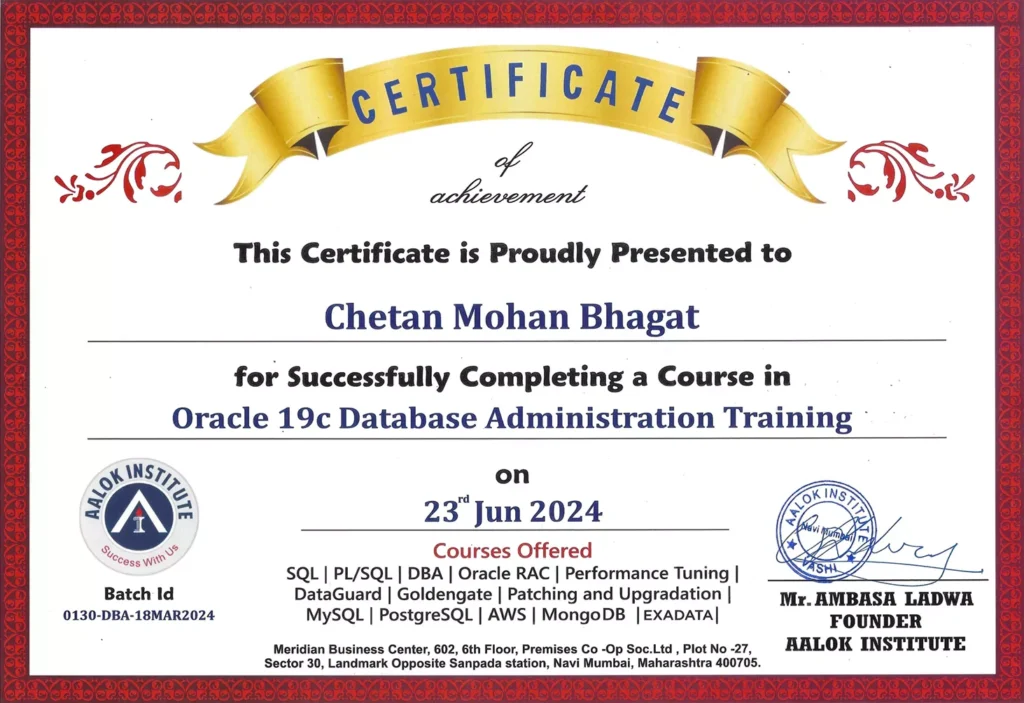
Exadata Database Machine Administration
Benefits Obtained :
- Live Online & Offline Classes
- PDF Study Materials & Notes Provided
- Real-Time Hands-On Practice
- Course Completion Certification
Why Join Aalok Institute for Exadata Training?
- Industry Experienced Trainers
- Real-Time Exadata Administration Scenarios
- Hands-On Database Infrastructure Training
- Small Batch Size for Personalized Attention
- Flexible Online & Classroom Training Options
- Job-Oriented Course Curriculum
Who Should Join This Courses?
This Course is ideal for:

Trusted by Professionals from Leading Companies
Students and working professionals from top organizations rely on Aalok Institute for practical DBA and cloud training.









Become an Oracle Exadata Specialist
Learn how to deploy, manage, and optimize enterprise-grade Oracle Exadata environments used by global enterprises.