
Oracle vs PostgreSQL comes down to this: Oracle is a commercial database with an enormous feature set and decades of use in banks and large enterprises, while PostgreSQL is a free, open-source database that now runs serious production systems too. For a DBA, the bigger differences are in how each one works day to day: how it handles concurrent changes, how you back it up, and how you keep it available.
This comparison is written from the DBA’s side of the desk. It covers what changes when you administer one instead of the other, the migration traps that catch people out, and which one to learn first if you’re building a DBA career in India.
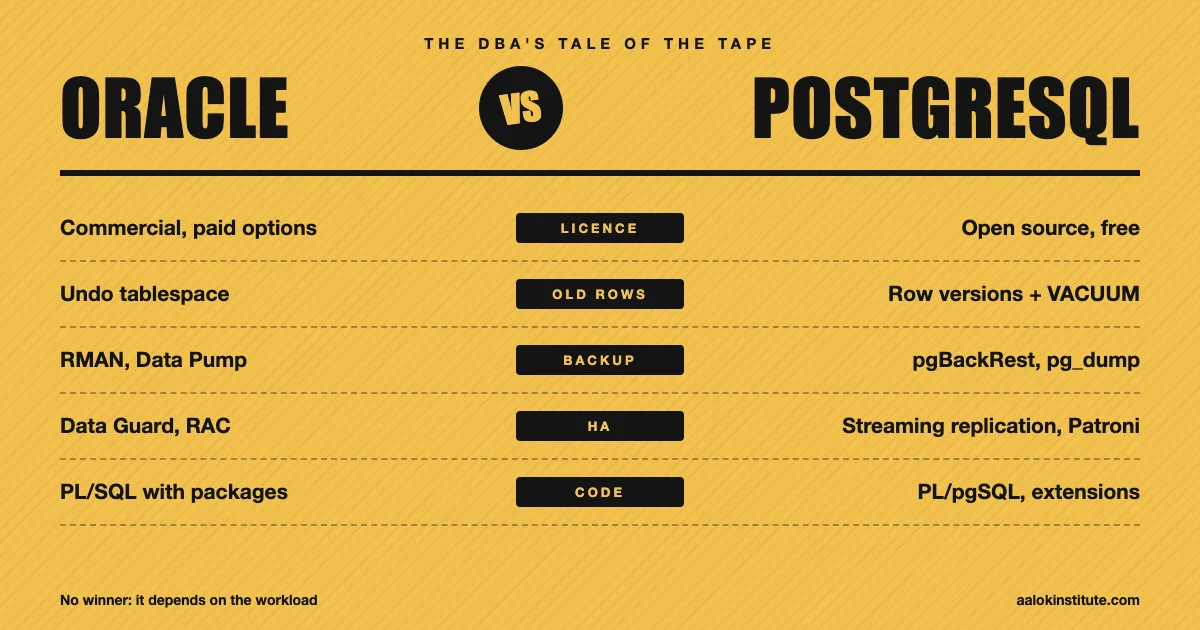
Oracle vs PostgreSQL at a glance
| Oracle Database | PostgreSQL | |
|---|---|---|
| Licence and cost | Commercial licence. Enterprise Edition options such as RAC, Partitioning and Active Data Guard, and the Diagnostics and Tuning Packs, are licensed separately | Free and open source under the PostgreSQL Licence, including for commercial use. Paid support is available from several vendors |
| Architecture | An instance (SGA, PGA and background processes) serving a database; multitenant CDB with pluggable databases | One server (“cluster”) holding many databases; a process per connection, shared_buffers plus the OS file cache |
| Concurrency (MVCC) | Rows are updated in place; old versions are rebuilt from undo | Every update writes a new row version; VACUUM removes the old ones |
| Change log | Online redo logs, archived to archive logs | Write-ahead log (WAL) in pg_wal, archived with archive_command or archive_library |
| Procedural language | PL/SQL, with packages | PL/pgSQL (no packages), plus functions in other languages such as Python |
| Backup | RMAN (physical, incremental), Data Pump (logical) | pg_basebackup and WAL archiving (physical), pg_dump (logical); pgBackRest or Barman in production |
| High availability | Data Guard; Active Data Guard (licensed) for queries on the standby | Streaming replication with readable standbys built in; Patroni or repmgr for automatic failover |
| Clustering | RAC: several instances, one database, shared storage | No shared-storage active-active clustering in core PostgreSQL |
| Partitioning | Partitioning option (Enterprise Edition): range, list, hash, interval, reference | Built-in declarative partitioning: range, list, hash |
| Extensions | Most features ship with the database or as licensed options | Large extension ecosystem: PostGIS, pg_stat_statements, pgvector, Citus and more |
| Cloud options | Oracle Cloud (Autonomous AI Database, Exadata Database Service), Oracle Database@Azure, @AWS and @Google Cloud, Amazon RDS for Oracle | Amazon RDS and Aurora, Azure Database for PostgreSQL, Google Cloud SQL and AlloyDB, OCI Database with PostgreSQL |
| Typical users in India | Banks, insurers, telecoms, government and large enterprises with packaged ERP and core systems | Product companies, SaaS and fintech, and a growing number of enterprises moving workloads off commercial databases |
Licensing and cost
Oracle is sold under a commercial licence, usually per processor or per Named User Plus, with annual support on top. Enterprise Edition is the edition most large systems run, and several of the features DBAs rely on are separately licensed options and packs on top of it: Real Application Clusters, Partitioning, Active Data Guard, and the Diagnostics and Tuning Packs that AWR, ASH and the SQL Tuning Advisor need. That last point surprises many juniors: querying most AWR (DBA_HIST_*) views, or V$ACTIVE_SESSION_HISTORY, without a Diagnostics Pack licence is a licence breach, even if you never open Enterprise Manager. Oracle also offers a free edition with strict resource limits (2 GB of RAM and 12 GB of user data), which is ideal for learning and development.
PostgreSQL is released under the PostgreSQL Licence, a short permissive licence in the same family as BSD and MIT. There are no editions and no paid options: replication, partitioning, readable standbys and monitoring views are all in the free download. Companies pay for hosting, managed cloud services or support contracts if they want them. For DBAs, this changes the conversation. On Oracle you regularly check whether a feature is licensed before you use it; on PostgreSQL you rarely have to.
Architecture differences
Memory and processes
An Oracle instance is the System Global Area (SGA), the Program Global Areas (PGA) and a set of background processes such as DBWn, LGWR, CKPT, SMON and PMON. On Linux, Oracle’s default dedicated-server mode also starts one server process per connection, but Oracle has built-in alternatives in shared server and Database Resident Connection Pooling.
PostgreSQL works the same way by default (one backend process per connection) but has no built-in pooler, so production systems put PgBouncer or a similar pooler in front. Its main cache is shared_buffers, which is usually sized much smaller than an Oracle buffer cache because PostgreSQL also relies on the operating system’s file cache. Memory for sorts and hashes is set per operation with work_mem, rather than as one PGA target.
Redo logs vs WAL
Both databases write changes to a log before the data files, and both use that log for crash recovery, point-in-time recovery and replication. Oracle writes to a fixed set of online redo log groups that are reused in a cycle, with filled logs copied to archive logs when the database runs in ARCHIVELOG mode. PostgreSQL writes WAL into segment files in pg_wal (16 MB by default). Once a checkpoint makes them unnecessary they are recycled or removed, and with archiving on, a segment is kept until it has been archived.
Databases, schemas and tablespaces
The words are the same but the meanings aren’t. In Oracle, a schema is a user and everything that user owns, and a tablespace is a logical container made of datafiles. In PostgreSQL, a schema is just a namespace inside a database, owned by a role, and a tablespace is simply a directory on disk. One PostgreSQL server also holds many separate databases, and a query can’t join across them without an extension such as postgres_fdw. The closest Oracle equivalent to that layout is a container database with several pluggable databases.
MVCC: undo vs row versions
This is the difference that changes a DBA’s daily work the most. Both databases let readers see a consistent snapshot without blocking writers, but they keep the old data in very different places.
Oracle updates rows in place and writes the previous version to the undo tablespace. When a query needs to see data as it was when the query started, Oracle rebuilds the old version of each block from undo. If that undo has already been overwritten, the query fails with ORA-01555 “snapshot too old”, which is why DBAs size the undo tablespace and set UNDO_RETENTION with the longest-running queries in mind.
PostgreSQL never updates in place. An UPDATE writes a completely new version of the row and marks the old one as dead; a DELETE just marks it dead. Old versions stay in the table until VACUUM removes them, normally run by autovacuum. There’s no undo tablespace and no ORA-01555, but there is bloat: if VACUUM falls behind, tables and indexes grow, and if it falls very far behind, transaction ID wraparound can stop the database accepting writes.
The trade-offs run both ways. A rollback in PostgreSQL is instant, because the new row versions are simply never marked as committed (they are left for VACUUM to clean up), while a large rollback in Oracle has to apply undo and can take as long as the original change, or longer. On the other hand, a PostgreSQL UPDATE usually has to add new index entries, unless it qualifies as a HOT update, and VACUUM tuning becomes a core DBA skill. Our PostgreSQL DBA interview questions spend a whole section on it for exactly that reason.
Backup and recovery
Oracle DBAs have RMAN, which does block-level physical backups, incremental backups with block change tracking, corruption checks, retention policies, standby creation with DUPLICATE and restores down to a single block. Data Pump (expdp and impdp) covers logical exports. Flashback features add another layer: you can query a table as it was earlier (as far back as undo allows), or, if Flashback Database is enabled, rewind the whole database without a restore. Block change tracking, block media recovery, Flashback Table and Flashback Database need Enterprise Edition.
PostgreSQL splits the same jobs across several tools. pg_dump takes logical backups of one database. pg_basebackup plus continuous WAL archiving gives physical backups and point-in-time recovery, and version 17 added incremental backups to it (with summarize_wal enabled, restored by combining the chain with pg_combinebackup). In production, many teams use pgBackRest or Barman on top, for retention, compression, parallelism and verification. There is no flashback query, so recovering a few deleted rows means a point-in-time restore to a separate server, or a delayed standby kept for the purpose.
Point-in-time recovery works on the same idea in both: restore a base backup, then replay archived logs up to just before the mistake.
High availability and scaling
Data Guard keeps one or more standby databases in sync by shipping redo, with three protection modes and automatic failover through the broker’s Fast-Start Failover (our guide to Oracle Data Guard architecture covers it in detail). A plain physical standby can’t be queried while it applies redo; that needs Active Data Guard, which is licensed separately.
PostgreSQL’s streaming replication does the same core job: standbys receive WAL and replay it, synchronously or asynchronously. Read-only queries on the standby are built in and free. What PostgreSQL doesn’t include is the failover automation: teams add Patroni (usually with etcd) or repmgr to detect a failed primary and promote a standby. Logical replication, built in since version 10, covers some of what Oracle shops buy GoldenGate for, such as replicating selected tables or upgrading with little downtime.
The honest gap is RAC. Oracle RAC runs several instances on different servers against one database on shared storage, all of them accepting writes. Core PostgreSQL has no equivalent. PostgreSQL setups scale reads with replicas and scale writes with bigger servers, application-level sharding or extensions such as Citus.
SQL and PL differences that bite during migration
Most Oracle SQL runs on PostgreSQL with small changes, but a handful of differences cause most of the bugs in a migration:
- Empty strings. Oracle treats
''as NULL; PostgreSQL treats it as an empty string. Code that checksIS NULLon text columns can quietly change behaviour. - DATE. An Oracle DATE includes the time of day. A PostgreSQL
datedoesn’t, so Oracle DATE columns usually map totimestamp(0). - Packages. PL/pgSQL has no packages. Package procedures become functions or procedures grouped in a schema, and package-level variables need another home.
- DUAL, ROWNUM and outer joins. PostgreSQL doesn’t need
FROM dual, usesLIMITorFETCH FIRST n ROWS ONLYinstead of ROWNUM, and doesn’t support the(+)outer-join syntax. - Sequences and functions.
seq.NEXTVALbecomesnextval('seq'), NVL becomes COALESCE, DECODE becomes CASE, and CONNECT BY becomes a recursive WITH query. Identity columns work in both. - Identifier case. Oracle folds unquoted names to upper case, PostgreSQL to lower case. Code that quotes upper-case names (such as
"CUSTOMERS"), or a schema migrated with quoted upper-case names, breaks unless names are handled consistently. - Transactions. In Oracle, DDL commits the current transaction automatically. In PostgreSQL, most DDL is transactional and can be rolled back (exceptions include CREATE DATABASE and CREATE INDEX CONCURRENTLY).
-- Oracle
SELECT NVL(city, 'NA') FROM customers WHERE ROWNUM <= 10;

-- PostgreSQL
SELECT COALESCE(city, 'NA') FROM customers LIMIT 10;
The open-source tool Ora2Pg exports an Oracle schema and data to PostgreSQL and produces an assessment report that estimates how much code needs manual work. Cloud providers offer their own conversion and migration services as well.
When to choose Oracle, and when PostgreSQL
Oracle tends to fit when:
- the application is a packaged product certified only on Oracle, such as many ERP and core banking systems
- you need active-active clustering on shared storage (RAC) or Exadata-level performance
- the team relies on Flashback, AWR and ADDM, and the licences are already in place
- a vendor contract or certification names Oracle specifically
PostgreSQL tends to fit when:
- licence cost is a major factor, or the system will run many separate databases
- the team builds its own applications and can choose the database
- extensions such as PostGIS or pgvector would replace a separate product
- the target is a managed cloud service such as Amazon RDS, Aurora or Azure Database for PostgreSQL
Plenty of organisations run both: Oracle for the core systems they can’t easily move, PostgreSQL for newer applications.
Which should you learn first as a DBA in India?
It depends on where you want to work, but for most people aiming at banking or IT services roles, Oracle first. It runs the core systems at many Indian banks, insurers, telecoms and large enterprises, and the IT services companies that support them hire Oracle DBAs in large numbers. Oracle also teaches you the concepts that every database shares, such as redo, undo, backup and recovery and execution plans, in a very structured way. Our Oracle DBA salary guide shows how pay grows with experience.
Then add PostgreSQL. Demand for PostgreSQL DBAs is growing as companies build new systems on it and move workloads off commercial databases, and many job descriptions now ask for both. An Oracle DBA who can also run PostgreSQL in production can apply for far more roles, and the second database is much quicker to learn than the first.
If you’re already working in a product company or startup where PostgreSQL is the main database, start there instead, and pick up Oracle when a role needs it.
Not sure which to start with? Aalok Institute teaches both, in an Oracle DBA programme and a PostgreSQL DBA programme with hands-on labs. Message us on WhatsApp to book a free demo class and talk it through with a trainer.
Frequently asked questions
Is PostgreSQL as good as Oracle?
It depends on the workload. PostgreSQL is mature and reliable and runs large production systems around the world. Oracle has features PostgreSQL lacks in core, such as RAC shared-disk clustering, Flashback and a very complete diagnostics and tuning toolset (AWR, ASH and ADDM, licensed separately as the Diagnostics and Tuning Packs). Which fits better depends on the workload, the budget and the skills of the team.
Can an Oracle DBA learn PostgreSQL quickly?
Yes. Most of an Oracle DBA’s knowledge carries over: SQL, transactions, backup and recovery, replication and tuning. The new parts are mainly MVCC with VACUUM instead of undo, the process and memory model, pg_hba.conf, and the PostgreSQL tools for backup and high availability. Many Oracle DBAs are productive on PostgreSQL within a few weeks of hands-on practice.
Is PostgreSQL free for commercial use?
Yes. PostgreSQL is released under the PostgreSQL Licence, a permissive open-source licence similar to the BSD and MIT licences. You can use, modify and distribute it in commercial products without paying licence fees. Companies usually pay only for hosting, managed cloud services or optional support.
Free demo class
Learn it hands-on, with trainers who work on real production databases
Aalok Institute runs live online and classroom batches in Oracle DBA, PostgreSQL, MySQL, MongoDB, Oracle Cloud and AWS. Tell us what you're preparing for, and we'll suggest the right batch and set up a free demo class.
Prefer a form? Send us an enquiry →- 4.8 ★on Google, from 684 reviews
- 12,000+students trained
- Vashi + onlineClassroom in Navi Mumbai, live online across India